
 English
 عربى
عربى
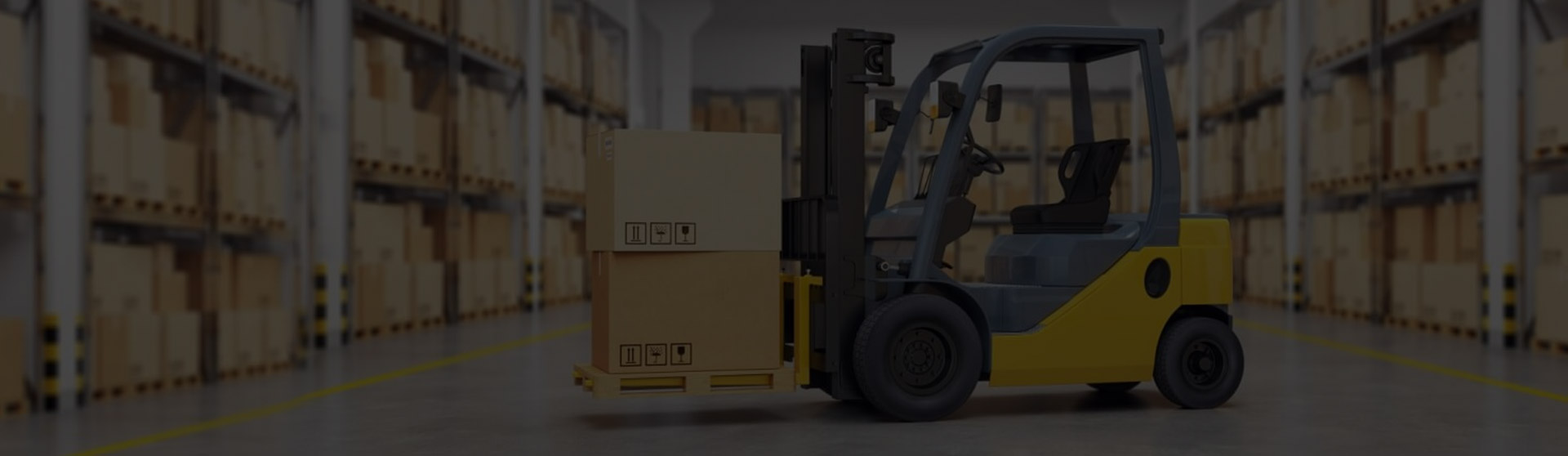

A tugger forklift pulls loads in a train instead of lifting them on forks, and that single difference decides which machine a warehouse should buy, how often its brakes need attention, and which spare parts belong on the shelf. If a shift needs thirty carts of components delivered to an assembly line but only four pallets lifted onto racking, a counterbalance truck is the wrong tool for most of that work.
Tow tractors, tuggers and warehouse tractors all describe the same family of machines: a compact unit with a tow pin or hitch at the rear, ballast over the drive axle, and a seat low enough for the operator to watch the train behind. Because they share frames, axles and hydraulic components with forklift trucks, they are frequently searched for and serviced as tugger forklifts, and forklift parts catalogues are where their replacement components usually come from.
Content
- 1 What Counts as a Tugger Forklift
- 2 Tugger Forklift vs Counterbalance Forklift
- 3 Brakes and Wheels: Where Towing Duty Bites First
- 4 Specification Checklist Before You Order a Brake Part
- 5 Daily Checks and Service Intervals
- 6 Safety Rules That Tugger Trains Demand
- 7 Sourcing Brake and Rim Parts Without Guesswork
What Counts as a Tugger Forklift
Most units in this class sit on a forklift-style frame. The drive axle, hydraulic pump, wheel hubs and often the brake hardware come from the equivalent battery or diesel forklift, while the front end carries a counterweight instead of a mast. That shared architecture is why a brake assembly, brake cylinder or steel rim listed for a 1.5 to 3 tonne forklift can be the correct part for a tow tractor in the same class.
Drawbar pull, not lift capacity
Tow tractors are rated by drawbar pull, expressed in newtons or kilograms of pulling force. A tractor rated at 2,000 kg of drawbar pull is expected to start and hold a train of six to eight tonnes of rolling load on level concrete. A lift truck of the same nominal tonnage is rated by load at a 500 mm load centre. The figures look comparable; the engineering behind them is not.
Tugger Forklift vs Counterbalance Forklift
Buyers who treat the two as interchangeable tend to discover the difference within the first month, when the brake pedal travels further than it did on the demonstration truck.
| Aspect | Tugger forklift (tow tractor) | Counterbalance forklift |
|---|---|---|
| Primary job | Tows carts and trailers in a train | Lifts, stacks and unloads pallets |
| Capacity rating | Drawbar pull (N or kg) | Rated load at load centre (kg) |
| Front and rear layout | Counterweight in front, tow hitch at rear | Mast and forks in front, counterweight at rear |
| Braking load | Machine plus the entire train | Machine plus the lifted load |
| Tyres and rims | Small solid or cushion tyres, often dual wheels | Pneumatic or solid tyres, larger rim sizes |
| Typical power source | Electric, 24 to 48 V, indoor plants | Diesel, LPG or electric |
A 2 tonne tow tractor pulling five 1 tonne carts is moving about 7 tonnes of mass. The same tractor with no trailers moves 2 tonnes. Every stop converts the difference into heat inside the brake drums, and the linings, cylinders and drums absorb all of it.
Brakes and Wheels: Where Towing Duty Bites First
At 8 km/h, a 7,000 kg train carries roughly 17 kJ of kinetic energy. A 1,500 kg forklift travelling at the same speed carries about 3.7 kJ, so each stop in a towing cycle has to be absorbed almost five times over. Sixty stops an hour turns that into a duty cycle rather than an occasional event, and the friction parts are the first to show it.
- Glazed lining that grabs sharply when cold and fades when hot
- Pedal travel that grows as drums and shoes wear
- Uneven left and right shoe wear caused by dragging brakes
- Fluid weeping past cylinder seals after repeated heat cycles
- Chunked solid tyres and cracks near rim welds from side loading
Hardware has to match the duty, not only the chassis. Single-pump and double-pump cylinders deliver different force, and widened shoes and widened cylinders exist precisely because heavier machines and repetitive stops need more lining area. On electric tow tractors in the 1.5 tonne class, the service brake assembly is usually shared with the equivalent battery forklift, which keeps spare parts simple to source.
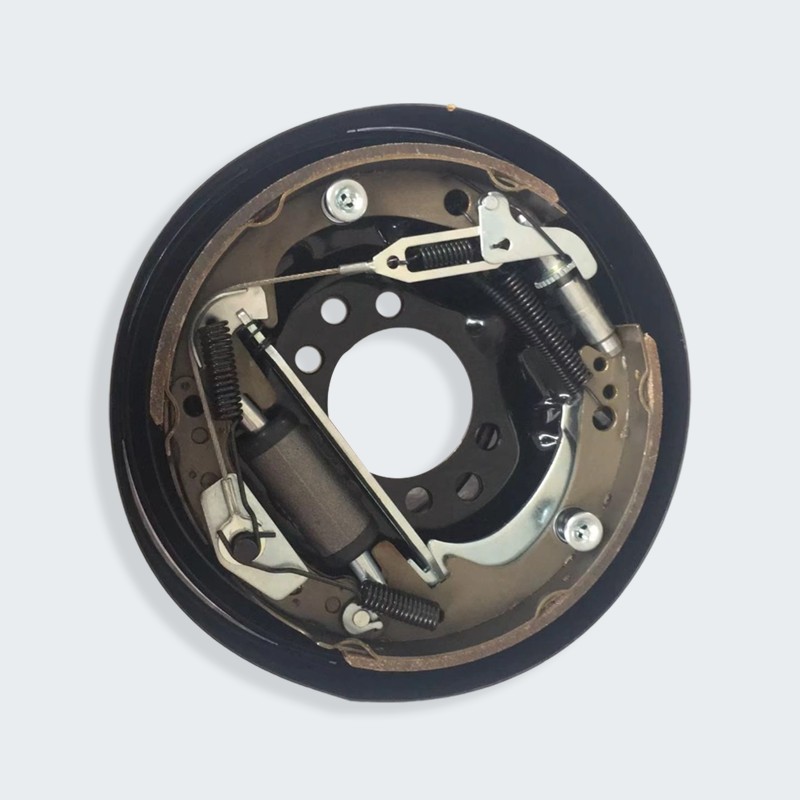 Electrical Liugong forklift 1.5 ton left brake assemblyThe left brake assembly of Liugong electric forklift is designed for 1.5-ton new energy vehicles and is the core unit to ensure the sensitive braking and safe operatio...View Product →
Specification Checklist Before You Order a Brake Part
Product names in a parts catalogue are compressed specifications. Reading them properly prevents most wrong shipments and the return freight that follows.
- Brand or series: mounting patterns differ between Hangcha, Heli, Toyota, Komatsu and Tailift even at the same tonnage.
- Tonnage class: 1.5, 2, 2.5, 3, 4.5, 5, 5.5 and 6 to 10 tonne machines use different assemblies.
- Side: left and right assemblies are mirror parts and are not interchangeable.
- Actuation type: single-pump or double-pump, and power-braking versus human-braking cylinders.
- Hole size: some 3 tonne models are supplied in big-hole and small-hole versions on the same axle.
- Width variant: widened shoes or cylinders for heavier axles and repetitive stop cycles.
- Parking brake style: hand-brake drum assemblies on 6 to 10 tonne machines are separate items from the service brake.
Get one line wrong and the part may bolt up but stop the machine unevenly, which is how a brake repair turns into a second repair. Confirm the four essentials first: brand, tonnage, side and brake type.
Daily Checks and Service Intervals
Every shift, before the train rolls
- Brake pedal feel and free play, checked with the train attached
- Tow pin, hitch and drawbar wear, including the retaining clip
- Tyre condition and chunking on solid or cushion tyres
- Brake fluid level and any fresh weeping at the cylinders
- Drum temperature by touch after a lap, a quick fade indicator
Every 500 operating hours or quarterly
- Measure shoe lining thickness and drum diameter against the wear limit
- Inspect cylinder seals and adjuster travel on both sides
- Check wheel bearing play and rim welds for cracks from side loading
- Verify parking brake holding force on the steepest ramp on site
Where a machine has run past the lining limit, a repair kit is usually the economical route: shoes, springs, seals and hardware in one set cost less than replacing each item separately, and they arrive matched to the same axle.
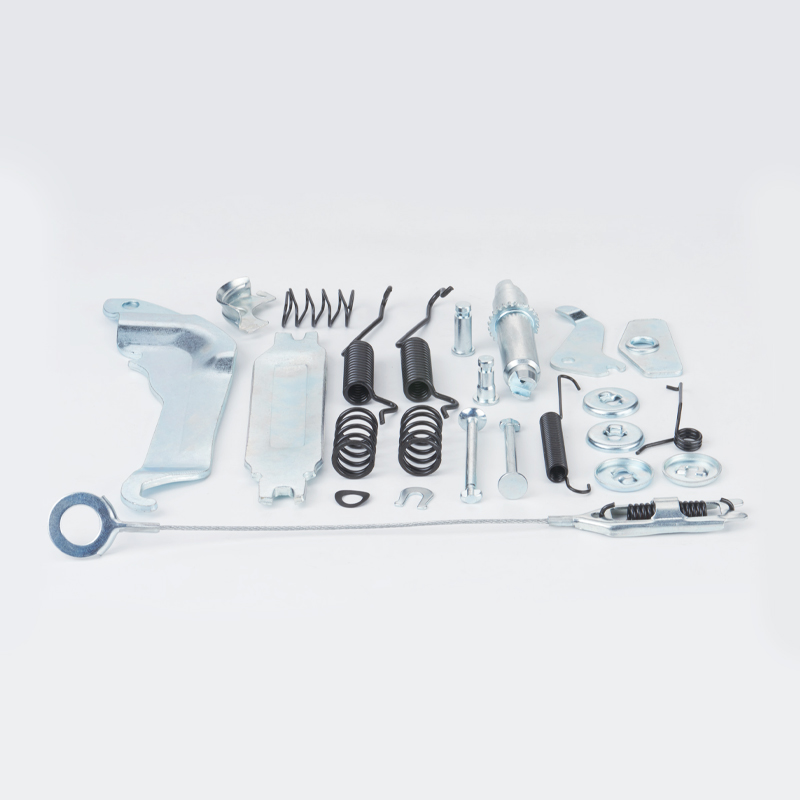 Hangzhou forklift/Heli forklift 3 ton brake repair kitThe Hangzhou Forklift/Heli Forklift 3 Ton Brake Repair Kit is designed to restore and enhance the braking performance of 3-ton forklift models, ensuring safe and effic...View Product →
Safety Rules That Tugger Trains Demand
A towing tractor is unforgiving about housekeeping. The U.S. Occupational Safety and Health Administration records an incident on 22 May 2019 in which an employee driving a tugger struck a parked forklift with its forks still raised in the air, and the tugger operator was killed. Two avoidable conditions met at once: a raised fork carriage left in a traffic route, and a tractor travelling without enough stopping distance.
- Lower forks and attachments fully whenever any truck is parked
- Keep pedestrians on separate marked routes and sound the horn at every doorway
- Limit train length to what the drawbar pull and brake system were rated for
- Hold aisle speed to walking pace and double the gap when the floor is wet
- Park with the hand brake set and chock the train on any incline
- Never carry riders and never tow with a worn or unclipped hitch pin
On heavy trains, or on ramps where a parked load must not creep, the parking brake does the holding rather than the service brake. Drum hand-brake assemblies built for 6 to 10 tonne machines are designed around that static load rather than a single stop.
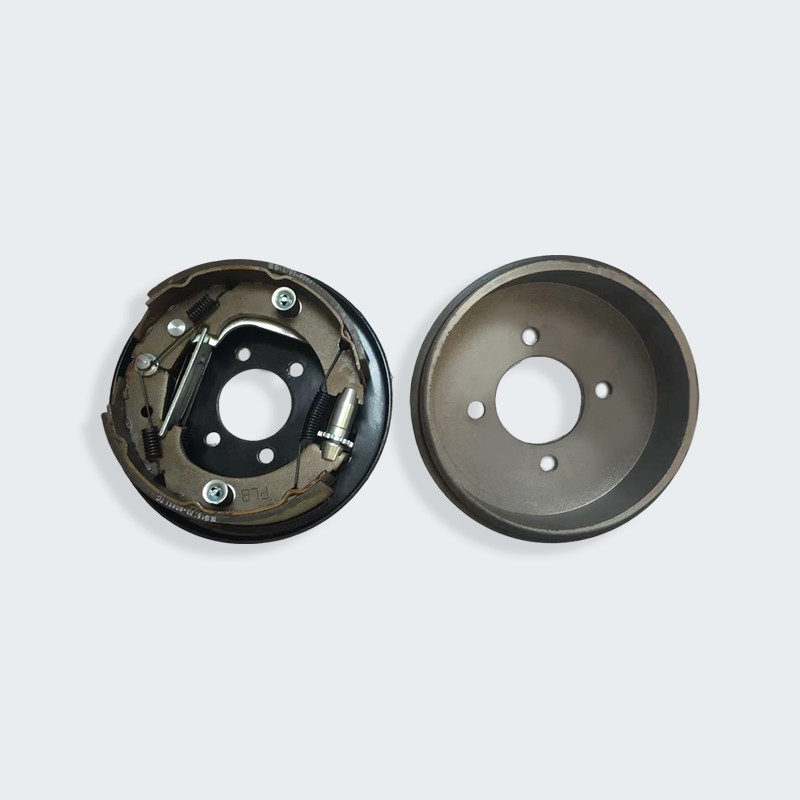 Hangcha forklift 6-10 ton hand brake drum brake assemblyAs the core brake component of Hangcha 6-10 ton forklifts, the handbrake drum brake assembly is designed with industrial-grade reliability as the core and is specially...View Product →
Sourcing Brake and Rim Parts Without Guesswork
Towing equipment sits in a narrow band of the market: low volumes, high duty cycles and a constant need for matched brake components. A supplier who already stocks 1 to 10 tonne forklift parts, plus battery truck components, is generally the faster route than ordering piece by piece. Our manufacturing and wholesale background explains the structure behind that, from brake system production to a stockholding of more than 10,000 part numbers.
Before committing to an order, ask three questions. Are the parts organised by brand, tonnage and side rather than by generic size? Is there stock on the shelf today, or is every line made to order? And can the supplier support a mixed load of brake assemblies, shoes, cylinders, repair kits and steel rims in one shipment? A short review of common causes of forklift brake failure is a useful checklist for deciding what to keep on the shelf for a towing fleet.
Treat the tugger forklift as what it is: a braking machine that happens to have a forklift driveline. Match the brake parts to brand, tonnage, side and actuation type, check shoes and drums every 500 hours, and keep one spare set of linings and a repair kit in the store. That routine costs very little compared with a train that cannot be stopped on a ramp, and it keeps a fleet of tow tractors doing the work they were bought for.
